Physically speaking, we cannot separate. We can not remove our respective sections from each other, nor build an impassable wall between them. A husband and wife may be divorced, and go out of the presence, and beyond the reach of each other; but the different parts of our country cannot do this. They cannot but remain face to face; and intercourse, either amicable or hostile, must continue between them. Is it possible, then, to make that intercourse more advantageous or more satisfactory, after separation than before? Can aliens make treaties easier than friends can make laws? Can treaties be more faithfully enforced between aliens than laws can among friends? Suppose you go to war, you cannot fight always; and when, after much loss on both sides, and no gain on either, you cease fighting, the identical old questions, as to terms of intercourse, are again upon you.
We know that Abraham Lincoln was one who did believe in "state rights." He states also in the first inaugural address, " That the maintenance inviolate of the rights of the States, and especially the right of each State to order and control its own domestic institutions according to its own judgment exclusively, is essential to that balance of power on which the perfection and endurance of our political fabric depend; and we denounce the lawless invasion by armed force of the soil of any State or Territory, no matter what pretext, as among the gravest of crimes." However, the issues if slavery had become far more important than to respect the rights of the states. He knew he could not just seperate the north and the south and allow the south to continue with the inequalities of slavery. It would be impossible to run a successful United States that way. I choose this passage because I like the correlation he makes between the states and a husband and wife.
Monday, November 14, 2011

Sunday, October 16, 2011
Midterm Questions
What are the advantages and disadvantages of dividing church and state and what were the views of the Puritans regarding church and state.
How and when did the constitution of the USA come about and how did the Federalist feel about it. Is the constitution as effective today.
How and when did the constitution of the USA come about and how did the Federalist feel about it. Is the constitution as effective today.
Hamilton
However Hamilton also saw that when businesses grow and expand they will pay more taxes and this will increase government revenue even more. Hamilton was willing then to sacrifice the lower classes in order to build up the upper classes (by taxing the poor more and letting investors run financial schemes) who would then provide the kind of financial support necessary for the kind of government he had in mind. This is why government and business hung together so closely in Hamilton's view. Business requires the government to use its power to create conditions good for business, and government relies on business for financing--that is the center of the relationship. Again a strong government would be able to gain the loyalty of the people and transfer their affections and loyalties from the states to the national state. The ultimate goal is to produce a sense of national unity and purpose among the people.
Hamilton strongly believed that the economies success heavily depended on the wealthy class. He states that in order for business to grow in size, the government needs the rich to use their money to invest in goverement companies. Since the rich would invest into the government they shouldn't be taxed largely. Taxing your investors could possibly make them reclutent to put their money into business. I choose this passage because it relates to the economic debates that we are experiencing now. With the loss of many jobs in America and many business laying off workers, our current president if looking for ways to help our lower and middle class citizens. President Obama proposed a bill which would give lower income citizen and small business a tax break and would tax the rich more. Many people are opposed to this bill because like Hamilton believe that the government shouldn't tax the rich because they are our investors and we wouldn't want to lose them or have them stop spending more in our economy.
Hamilton strongly believed that the economies success heavily depended on the wealthy class. He states that in order for business to grow in size, the government needs the rich to use their money to invest in goverement companies. Since the rich would invest into the government they shouldn't be taxed largely. Taxing your investors could possibly make them reclutent to put their money into business. I choose this passage because it relates to the economic debates that we are experiencing now. With the loss of many jobs in America and many business laying off workers, our current president if looking for ways to help our lower and middle class citizens. President Obama proposed a bill which would give lower income citizen and small business a tax break and would tax the rich more. Many people are opposed to this bill because like Hamilton believe that the government shouldn't tax the rich because they are our investors and we wouldn't want to lose them or have them stop spending more in our economy.
Friday, October 14, 2011
The Address and Reasons of Dissent of the Minority of the Convention of Pennsylvania to their Constituents
The Continental convention met in the city of Philadelphia at the time appointed. It was composed of some men of excellent characters; of others who were more remarkable for their ambition and cunning, than their patriotism; and of some who had been opponents to the independence of the United States. The delegates from Pennsylvania were, six of them, uniform and decided opponents to the constitution of this commonwealth. The convention sat upwards of four months. The doors were kept shut, and the members brought under the most solemn engagements of secrecy. Some of those who opposed their going so far beyond their powers, retired, hopeless, from the convention others had the firmness to refuse signing the plan altogether, and many who did sign it, did it not as a system they wholly approved, but as the best that could be then obtained, and notwithstanding the time spent on this subject, it is agreed on all hands to be a work of haste and accommodation.
The Federalist No. 10 Madison
"By a faction, I understand a number of citizens, whether amounting to a majority or a minority of the whole, who are united and actuated by some common impulse of passion, or of interest, adversed to the rights of other citizens, or to the permanent and aggregate interests of the community.
There are two methods of curing the mischiefs of faction: the one, by removing its causes; the other, by controlling its effects.
There are again two methods of removing the causes of faction: the one, by destroying the liberty which is essential to its existence; the other, by giving to every citizen the same opinions, the same passions, and the same interests.
It could never be more truly said than of the first remedy, that it was worse than the disease. Liberty is to faction what air is to fire, an aliment without which it instantly expires. But it could not be less folly to abolish liberty, which is essential to political life, because it nourishes faction, than it would be to wish the annihilation of air, which is essential to animal life, because it imparts to fire its destructive agency."
There are two methods of curing the mischiefs of faction: the one, by removing its causes; the other, by controlling its effects.
There are again two methods of removing the causes of faction: the one, by destroying the liberty which is essential to its existence; the other, by giving to every citizen the same opinions, the same passions, and the same interests.
It could never be more truly said than of the first remedy, that it was worse than the disease. Liberty is to faction what air is to fire, an aliment without which it instantly expires. But it could not be less folly to abolish liberty, which is essential to political life, because it nourishes faction, than it would be to wish the annihilation of air, which is essential to animal life, because it imparts to fire its destructive agency."
Madison believed that fractions were the reasons for the issues the government and community were facing. He thought that fractions such as unequal distribution of property and the conquest of the minority over the majority were not of interest of the community. He felt by removing these fractions “destroying Liberty” and by giving all citizens equal rights and interest could merely solve these issues.
Madison is correct in one sense however with everything there are pros and cons. Maybe in the 1700”s they could have been more effective convincing the people of having the same interest with only a minority disagreeing but that could never happen in the 21st century where everyone demands self interest.
Tuesday, September 27, 2011
U.S. Constitution
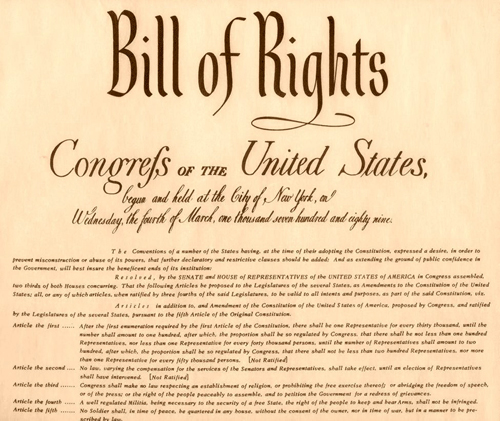
Article I
After the first enumeration required by the first article of the Constitution, there shall be one representative for every thirty thousand, until the number shall amount to one hundred, after which the proportion shall be so regulated by Congress, that there shall be not less than one hundred representatives, nor less than one representative for every forty thousand persons, until the number of representatives shall amount to two hundred; after which the proportion shall be so regulated by Congress, that there shall be not less than two hundred representatives, nor more than one representative for every fifty thousand persons.Article II
No law varying the compensation for the services of the Senators and Representatives, shall take effect, until an election of Representatives shall have intervened.Article III
Congress shall make no law respecting an establishment of religion, or prohibiting the free exercise thereof; or abridging the freedom of speech, or of the press; or the right of the people peaceably to assemble, and to petition the Government for a redress of grievances.Article IV
A well regulated Militia, being necessary to the security of a free State, the right of the people to keep and bear Arms, shall not be infringed.Article V
No Soldier shall, in time of peace be quartered in any house, without the consent of the Owner, nor in time of war, but in a manner to be prescribed by law.Article VI
The right of the people to be secure in their persons, houses, papers, and effects, against unreasonable searches and seizures, shall not be violated, and no Warrants shall issue, but upon probable cause, supported by Oath or affirmation, and particularly describing the place to be searched, and the persons or things to be seized.Article VII
No person shall be held to answer for a capital, or otherwise infamous crime, unless on a presentment or indictment of a Grand Jury, except in cases arising in the land or naval forces, or in the Militia, when in actual service in time of War or public danger; nor shall any person be subject for the same offence to be twice put in jeopardy of life or limb; nor shall be compelled in any criminal case to be a witness against himself, nor be deprived of life, liberty, or property, without due process of law; nor shall private property be taken for public use, without just compensation.Article VIII
In all criminal prosecutions, the accused shall enjoy the right to a speedy and public trial, by an impartial jury of the State and district wherein the crime shall have been committed, which district shall have been previously ascertained by law, and to be informed of the nature and cause of the accusation; to be confronted with the witnesses against him; to have compulsory process for obtaining witnesses in his favor, and to have the Assistance of Counsel for his defence.Article IX
In Suits at common law, where the value in controversy shall exceed twenty dollars, the right of trial by jury shall be preserved, and no fact tried by a jury, shall be otherwise re-examined in any Court of the United States, than according to the rules of the common law.Article X
Excessive bail shall not be required, nor excessive fines imposed, nor cruel and unusual punishments inflicted.Article XI
The enumeration in the Constitution, of certain rights, shall not be construed to deny or disparage others retained by the people.Article XII
The powers not delegated to the United States by the Constitution, nor prohibited by it to the States, are reserved to the States respectively, or to the people.The Bill of rights is a declaration of individual rights and freedoms given by the government; they are the rights of the American citizens and it is to ensure that those rights are not infringed.The Bill of rights is a respected piece of historical document. It served it's purpose centuries ago however is totally outdated. In order for it to served it's purpose for the 21 century citizens of America it would need to be revised.
Thursday, September 8, 2011
What Chesterton Saw in America
"Let me begin my American impressions with two impressions I had before I went to America. One was an incident and the other an idea; and when taken together they illustrate the attitude I mean. The first principle is that nobody should be ashamed of thinking a thing funny because it is foreign; the second is that he should be ashamed of thinking it wrong because it is funny. The reaction of his senses and superficial habits of mind against something new, and to him abnormal, is a perfectly healthy reaction. But the mind which imagines that mere unfamiliarity can possibly prove anything about inferiority is a very inadequate mind. It is inadequate even in criticising things that may really be inferior to the things involved[Pg 3] here. It is far better to laugh at a negro for having a black face than to sneer at him for having a sloping skull. It is proportionally even more preferable to laugh rather than judge in dealing with highly civilised peoples. Therefore I put at the beginning two working examples of what I felt about America before I saw it; the sort of thing that a man has a right to enjoy as a joke, and the sort of thing he has a duty to understand and respect, because it is the explanation of the joke." (Chesterton, G.K. What I Saw in America. Great Britian: T. and A. CONSTABLE LTD. 1922)
(2)Interpretation
It is natural for a person to see or hear something abnormal or unrecognizable and laugh. The unfamiliarity or ignorance or even arrogance most likely is triggered by inferiority. It is not the more appropriate to laugh than to judge or criticize yet more instinct response.
(3) I choose this quote because of the way he explained our natural response to unfamiliarity which is in fact our reality and this quote really makes one stop and ponder: Do I do the same?
Subscribe to:
Posts (Atom)